
Art in the Open
Exploring public art from Campbell River to Mill Bay
You don’t always need to step inside a gallery to find some of the best art on Central Vancouver Island. It turns up beside beaches and walking trails, in parks and on downtown streets—sometimes monumental, sometimes whimsical and occasionally destined to disappear with the next good rainstorm.
From Campbell River to Mill Bay, public art tells stories about the places we live, the people who came before us and the landscape that surrounds us.
In Campbell River, some of the most engaging works begin with that landscape—quite literally. Local artist Alex Witcombe turns driftwood into enormous animals that have become landmark pieces of art. His creations include Drift – The Whale, a humpback at Ken Forde Park, and Chadwick the Cougar on Tyee Spit.
Wood also takes centre stage at Frank James Park, home to Transformations on the Shore, Campbell River’s annual driftwood carving competition. Launched in 1997, the event brings local and visiting artists together to transform weathered pieces of wood into sculptures, with carvings displayed along Rotary Seawalk and elsewhere in the city. The result is a fascinating outdoor gallery.
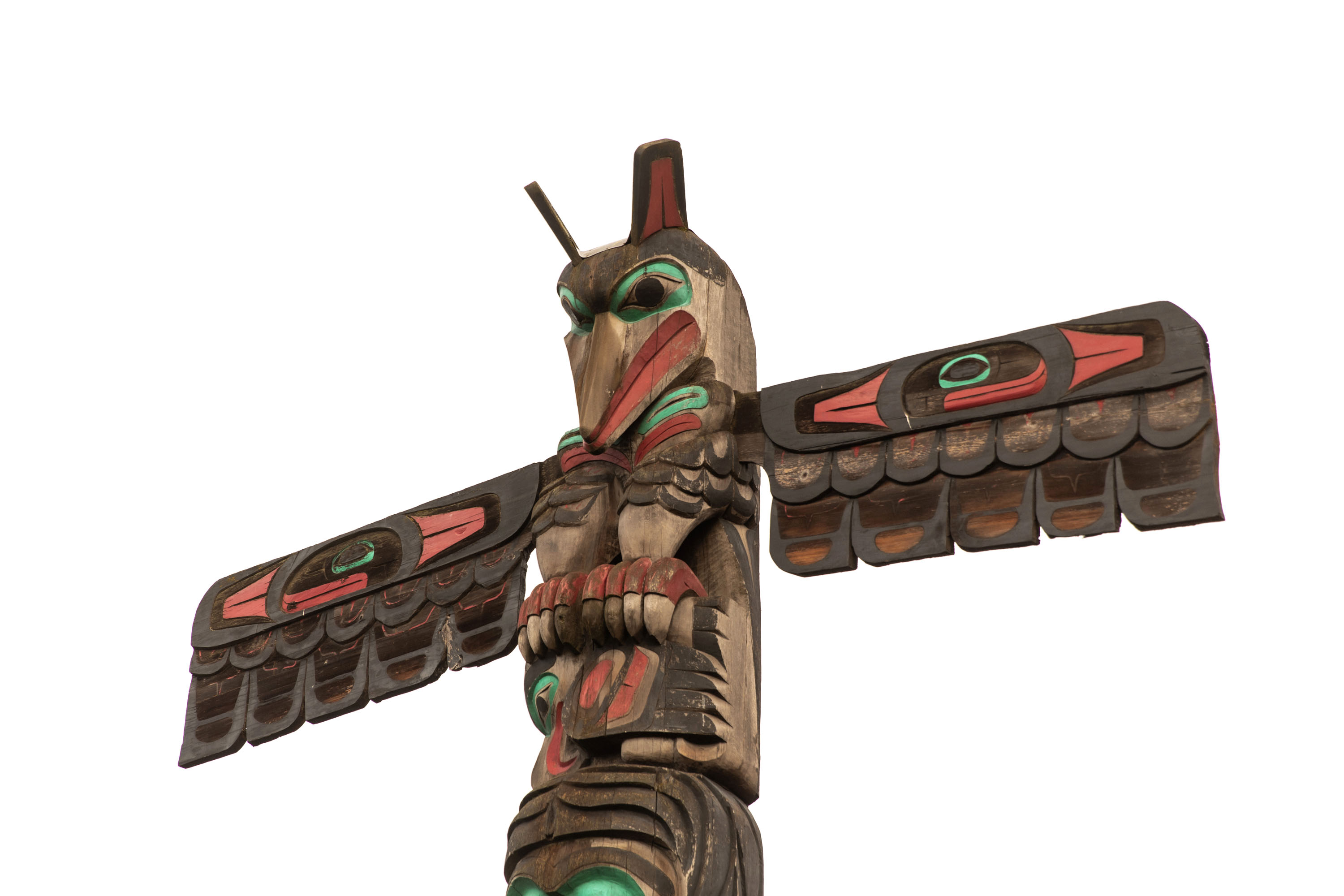
Farther south, Courtenay offers public art with a strong connection to the people who have inhabited the region for thousands of years. In 2022, a Guardian pole carved by K’ómoks First Nation artist Karver Everson was raised beside the Courtenay Riverway Heritage Walk, overlooking the K’ómoks Estuary. The installation was a collaboration between the K’ómoks First Nation and the City of Courtenay and part of the wider Guardian Pole Project, which has seen poles raised throughout the Comox Valley and surrounding islands. Everson’s presence in the valley continues to grow: he has also been selected to carve a totem pole for the Glacier View Roundabout in Comox.
In Qualicum Beach, a prominent piece of public art now greets visitors at the waterfront. Installed in 2024, the centrepiece of the Memorial Avenue roundabout was designed by Qualicum First Nation artist Jesse Recalma. The illuminated artwork features an eagle and bear and connects the site with an earlier Simon Charlie pole that stood near the waterfront for decades.
Art also flies overhead here. Qualicum Beach’s Street Banner Artists Program drew more than 100 submissions from across Vancouver Island, with 10 works by six local artists selected for display. The banners bring art into the everyday streetscape, with designs reflecting everything from the surrounding mountains and coastline to local history and culture.
Parksville, meanwhile, proves public art doesn’t have to last forever. Each summer, the beach becomes an outdoor sculpture gallery during the Quality Foods Sand Sculpting Competition and Exhibition. This year, 30 sculptors transformed 255 cubic yards of sand into works inspired by the theme Beauties & Beasts. The 2026 winning solo sculpture, Walls, was created by PEI artist Abe Waterman. The exhibition remained at Parksville Community Park through August 16—and then, as it does every year, the art disappeared.
If Parksville specializes in the ephemeral, Nanaimo has embraced public art on almost every scale, with permanent works joined by a Temporary Public Art Program that puts new pieces into parks and other civic spaces.
Among the newest is Forest Flowers, unveiled in May at Kinette Evergreen Park. Created by Nanaimo artists Eliza Gardiner and Isaiah Kingdon, the installation features three oversized flowers, standing six to nine feet tall and inspired by the rare Crown Brodiaea found in the Harewood Plains. Made from powder-coated steel and translucent acrylic, the flowers cast coloured light onto the surrounding park and will remain on display through 2031.
Another recent project takes an entirely different approach. Twyla Exner’s Encrustation: Barnacles of Belonging invites community members to create barnacle forms that will eventually become part of a waterfront installation. And in June, Snuneymuxw artist Eliot White-Hill, Kwulasultun, unveiled Siwul tu Tumuxw (Notice the Land), a sound installation that sends recordings of birds native to Snuneymuxw territory from discreet speakers along Wesley Street.
Few island communities, however, are as closely identified with public art as Duncan. Its collection of more than 40 totem poles began as a civic project in the 1980s and has grown into one of the world’s largest outdoor collections of publicly displayed totem poles. Today, yellow footprints lead visitors on a self-guided walking tour through downtown, with signs accompanying each pole and sharing the stories gathered through oral histories with the carvers and their families.
And then there’s Mill Bay, where public art has taken a less conventional form. Last summer, the community was the setting for INTERVENE, a temporary land-art project presented by STEPS Public Art in partnership with the Victoria Arts Council. Five artists created site-specific installations using natural and found materials, drawing inspiration from Shawnigan Creek and the surrounding environment. The works were temporary, but perhaps that was part of the point: the landscape wasn’t simply a backdrop for the art; it was part of it.
And this might be what links Central Island public art. A driftwood whale, a street banner, a towering pole and a sculpture made of sand have little in common as objects. But put them outside, where people encounter them on the way to work, walking the dog or heading to the beach, and art becomes part of the place itself.